In the heart of the mountains by Sandeep Silas, published in The Hindu

In the heart of the mountains by Sandeep Silas

12dmc_threesisters1_112962f


Man has been building in statuesque, grandiose and ornate architectural styles since the time stone was quarried and bricks fired. Imagination, force of will, ornamentation and sheer celebration is visible in what he has built the world over! And, that is what I saw in the Blue Mountains, 110 km. from Sydney.

As I sped towards the Blue Mountains, the whole atmosphere changed and Nature started speaking in hushed tones. The road wound its way up through dreamy villages wrapped in slumber. At Glenbrook came the gateway, and Wentworth Falls was pretty. Charles Darwin, who laboured to unravel the mystery of the origin of species, once stayed here, and a walk commemorates this association.

The village of Leura romanticises candles and clothing. In October, Cherry blossoms line the streets of Leura, and gardens are filled with butterflies sipping nectar. We halted at bohemian Katoomba, and I particularly remember the sloping drive through the village. Homes are old fashioned and the boutiques bright. The post office, the bank and the church remind you of temporal and spiritual connections.

ABORGINAL LEGEND

Gavin, my chauffeur, mentioned the Three Sisters. I presumed he was recounting a fable, bringing back to life the days of the Aborigines. Till, I I realised the Three Sisters is a prominent feature of the Blue Mountains World Heritage area, which celebrates Nature.

There is an Aborginal legend associated with the three sisters The beautiful sisters, Meenhi, Weemala and Gunnedoo, daughters of the Katoomba tribe’s witch doctor, fell madly in love with three brothers of the Nepean tribe. Ancestral law forbade marriage outside the tribe. The brave warrior-brothers engaged in battle for the maidens. The witch doctor turned his daughters to stone using his magic stick, intending to restore them to life after the fight. But, he was killed in battle and his magic stick could not be found. They say the Lyrebird instinctively scratches the earth even today, searching for the magic stick.

The Blue Mountains, belonging to the Narrabeen Group of layers, have evolved over hundreds of millions of years. The Three Sisters were once seven sisters. Four have been lost to the Valley, the weather and Time!

I saw a wooden signboard; ‘The Three Sisters’, and took the path. At a view point, I was amazed at the vastness of the range and the Leura Forest in the valley. The forest reverberated with birdcall. Inching further, I was face-to-face with a mountaintop, the edges of which were jagged — victims of wind erosion.

A bench in a cavity of the cliff invited me to solitude. Touching the cliff, I wondered where the ‘Three Sisters’ were located. All lookouts were blocked by the heavy mist. Disappointed, I rose and took to what they call ‘The Giant Staircase’, which takes you deep down to the forest.

I trudged back to the starting point, I followed some visitors to Echo Point to share a glimpse of what they saw — the three lovelorn sisters, captives of fate, stood a little to my left in storybook silence. For a brief moment, the majestic sun illuminated their dormant sensuousness.

And, to think that all this while, I had actually sat and brooded on the waist curve of one of the three!

(Published in The Hindu May 2, 2010)

Link:

http://www.thehindu.com/features/metroplus/in-the-heart-of-the-mountains/article419085.ece

Keywords: Blue MountainsThree Sisters

Civil servant, travel writer and poet Sandeep Silas strings a garland of peace, write-up in THE HINDU Oct 21, 2009

Civil servant, travel writer and poet Sandeep Silas strings a garland of peace

The Hindu covered the Launch ceremony of “Garland Of Peace” idea and initiative on October 21, 200922dmc_sandeep02_jpg_j_8895g 22dmc_sandeep03_jpg_j_8896g

Link:

http://www.thehindu.com/features/friday-review/art/peace-strings/article36681.ece

http://www.thehindu.com/multimedia/dynamic/00008/22dmc_sandeep02_jpg_J_8895g.jpg

The recently concluded photo exhibition by Sandeep Silas at the India Habitat Centre propagates war ravaged sites of the world to be united in a “Garland of Peace.”

Each country of the world has hidden its war wounds for reasons of disgust, shame and hurt national pride.

He feels that so classified war ruins and sites can create a powerful movement for peace amongst all nations.

Images of Hiroshima and Pearl Harbor on the same platform along with sites like Lion Hill, Waterloo, Belgium; Menin Gate in the town of Ypres, Belgium; the Auschwitz concentration camps; Anzac Cove, Turkey; Fort Siloso in Singapore; Bridge on the River Kwai, Thailand; St. Paul’s Church, Ambala, India; the Berlin Wall, Germany, and the Bamiyan Buddhas, Afghanistan, were on display as reminders of past wars. Quotes and thoughts of Gandhi and Nehru on peace and war were thought provoking.

Let there be peace

Silas belongs to the rare group of crusaders whose formidable asset is the cerebral world of ideas. Such is his ability that the ideas grow faster than grass and thought in layers, as enumerated in the Yaksh Prashna put to Yudhishthir in the Mahabharat.

The idea is to declare war-ravaged world sites and buildings as peace heritage sites.

The concept “Garland of Peace” is to string these ruins and sites into a garland of peace building, peace education, peace tourism and peace activism having a lasting influence on present and future generations — the leaders of tomorrow.

To delve further, Silas suggests formation of a peace heritage committee by the United Nations with the objectives of identifying the ruins, preserving them, and putting into place a mechanism to develop these sites as the property of the world community, as the indifference and neglect of the nations gives rise to feelings of revenge and hate towards the aggressor.

The esoteric idea may emerge in a form that seems formidable, but already the impossible has been made possible. The Wailing Wall at Jerusalem is worshiped by the Jews and the Muslims. Similarly in India, Kurukshetra, the battleground of the epic Mahabharata, is a place of pilgrimage to understand the futility of war and learn the essence of the Gita.

Silas, while following the doctrine of the Gita, i.e., do your duty without expecting the reward, has tasted the fruits of his ideas.

As a civil servant, travel writer, poet, he has successfully implemented the concept of a mobile science exhibition on rails in 2003.

“Discover India by Rail” (Sterling publication), “Morrows Face” and “Borrows in the Mist” are significant contributions to the world of poetry. Recently the Sri Lankan government has accepted his suggestion of a Sita-Ram heritage tourism trail in Sri Lanka for the promotion of tourism.

Life is beautiful

Now busy with his novel concept, “Garland of Peace”, he feels that life is beautiful and unique, and let there be no “apocalyptic third war”. Torture, atrocities and humiliation are natural consequences of war, and by wearing the “Garland of Peace” he resolves to prevent war.

With his thought-provoking concept, he has already been well received by stalwarts such as Karan Singh, Kapila Vatsayan, Martand Singh (INTACH) and his alma-mater, the Maxwell School, New York.

Jazba

360

123654

123654-copy

Jazba (Passion)

Like nectar rises my passion to the flower

Whosoever tasted said, ‘sweet like honey’


Like deep lines etched on snowy mountains

I lie silent on the rocky bed below the snow


Give me some sun, let me melt and reach you

My core is water, give me favour of your mercy


I halted thinking that the road was my destination

In a magic like grip I was, my life was in a bind


Touch me and wake me, let eyes not get dimmed

Hold me, pick me up, silent is all congregation


Give me some laughter, give me some smartness

Wish me a prayer to rise and blossom next season


Jazba by Sandeep Silas ‘deep’ in Saada Khayal (2009)


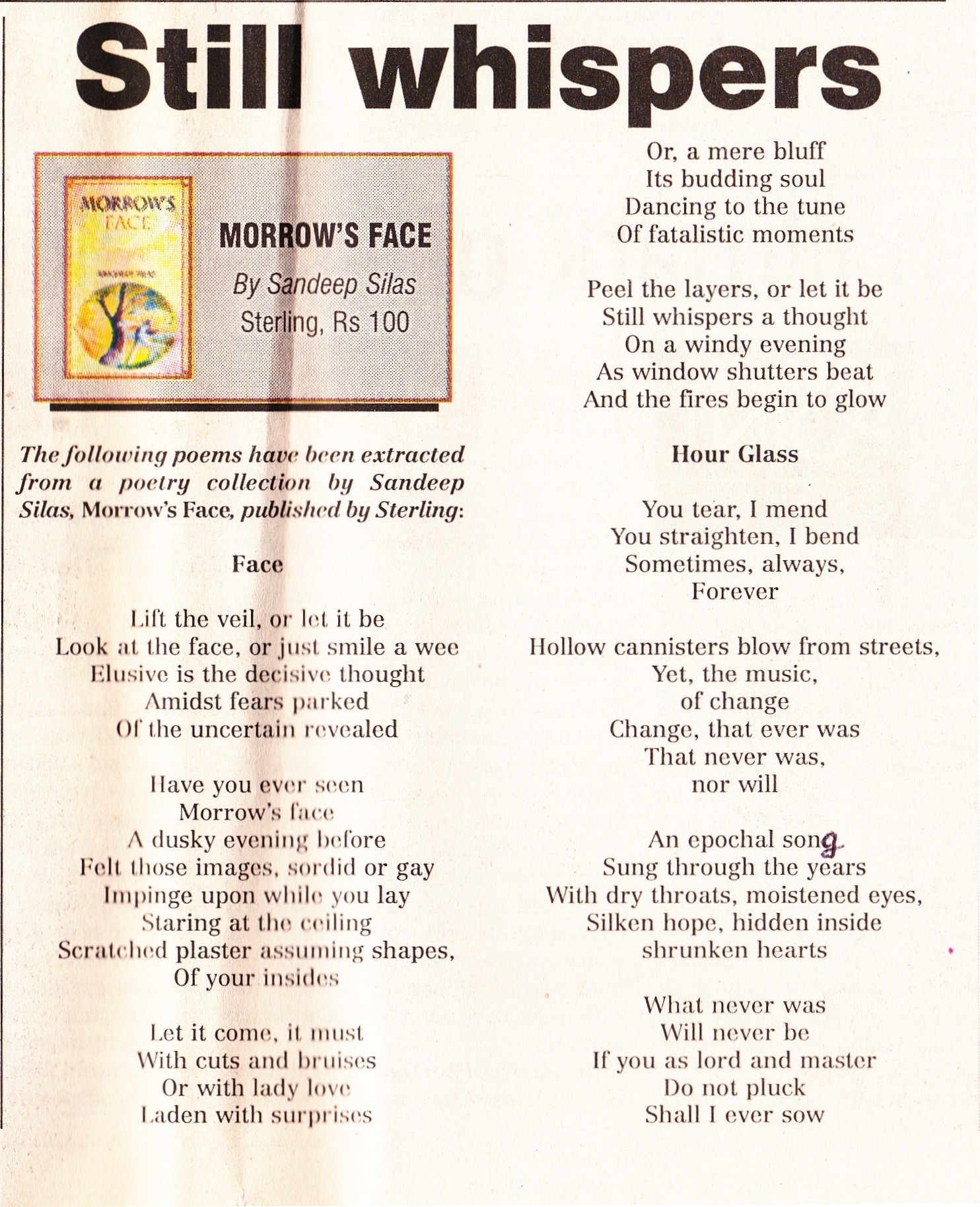
Morrow’s Face…my first book of poems

The First Whispers of the Muse!

Morrow’s Face, 2005

the-pioneer-april-10-2005

(Foreword and editing by late Shri Keshav Malik; Sterling Publishers Pvt Ltd)


Swaraj On A Third Class Ticket

My personal tribute to Mahatma Gandhi!

I always say that Gandhi travelled and the Mahatma was born on a third class compartment of an Indian train!

Indian Express Oct 8, 2000

Indian Express Oct 8, 2000 contd

(Indian Express October 8, 2000)

Tribute to all my Teachers on ‘Teachers Day’…taught me to face the drama of life with grace!

Once you act a Shakespearean drama on stage with grace and poise, you are empowered to face life like a King or Queen!

So was OTHELLO…at St. John’s College, Agra 1979!

Othello, Mar 1979, St. John's, Agra

Othello Cast

I salute all my teachers who have taught me at St. Peter’s College, Agra; St. John’s College, Agra; Manchester Business School, Manchester, UK; Maxwell School of Citizenship & Public Affairs, Syracuse University, New York, USA!

They gave me the power to live life as I want; strive to bring reform and transformation in systems and processes; think positive in all circumstances; and to be creative every moment of life!

From my Archives…St. John’s College, Agra- Festival of One-Act Plays 1978

Excellence in every sphere !

Festival of One Act Plays, Dec 1978, St. John's Agra

Festival Sheet 1, Dec 1978

Festival Sheet 2, Dec 1978

Festival Sheet 3, Dec 1978

Maid of the Mist

118

Maid of the Mist

Maid of the Mist by Sandeep Silas in Rainbows Don’t Last Forever (2012)

Book available on Amazon:

https://www.amazon.in/RAINBOWS-DONT-FOREVER-Sandeep-Silas-ebook/dp/B007VDJEX8

Tum

123654

123654 - Copy

172

You

When breath rises and conversations go on

Why do silences still linger between lips?


With you before me, love, intoxication, I lived

Far you are today, and I am near, I am love


We go on moving like breath in unknown spaces

‘Deep’ will utter the name that lives in breath when he rests

Tum by Sandeep Silas ‘deep’ in Saada Khayal (2009)